Saturday, April 21, 2012

HAPPY SAN JACINTO DAY


“Texas has four seasons: Drought, Flood, Blizzard, and Twister” Unknown


The 1836 season was off to a bad start; slaughtered in San Antonio on March 6 and massacred March 27 at Goliad.  Upstarts are known to get off to a slow start, but one more loss and there may not be a ’37 season.  Critics will look back and say they were underfunded, undermanned, and the facilities were over a hundred years old.  The spectators had all but given up and were leaving in record numbers.  The writers were not even covering the action anymore.  One match left and it had to be a decisive win.

1835 had been such a great start.  After being a part of the Mexican Provisional league since 1824, the Texans thought it was time to move up.  In fact, the Mexican President thought so little of the Texans that they were combined with Coahila.  It had been no more than a couple of scrimmages against a “B” team, but wins at Gonzales and San Antonio late in the year had gotten the Texans believing they could fight it out with the big boys.  Sam Houston was in charge of the Texans and saw things differently.  He wanted no part of the Mexican Nationals and began gauging interest in Washington DC to see if the American League was interested in expansion.  The American League had been a British minor league for a long time, but 60 years ago they had their own break out season and had firmly established themselves as a true world power.  The problem with the Americans 1836 was that they played by different rules within their league.  The Southern Division used the Designated Worker, whereas the Northern Division did not.  Although not unanimous, most of the Texans liked the Designated Worker rule.  The governing body had decided in 1820 that the two divisions had to be balanced.  So for the Texans to join the American league, another team in the northern minors had to be invited up.  It was deemed too early for expansion, so Texas had to either stay in the Mexican Provisional League or form their own.  

All of this was viewed differently by the Mexican Nationals.  They had been a part of the Spanish League for a couple of hundred years and were just getting comfortable with the rest of the world leagues.  They viewed Texas as a key feeder to the mother team and had absolutely no interest in allowing another league to form in their backyard.  After the “B” team was embarrassed, Santa Ana who was the National’s owner called home the entire management, pulled a Jerry Jones and installed himself as general manager.  He declared that he would play all road games and completely destroy the Texan team.  So in January 1836, off to Texas Santa Ana went.  At San Antonio, Santa Ana took on the Travis Texans.  It was looking bleak for the Texans until some veteran free agents from Tennessee known as the Crocketts came to town.  Santa Ana had a real fight on his hand and for 12 days they fought to a draw.  But although Travis’s first team was as good as they came, he just had no depth.  And depth was something that Santa Ana had plenty of. On the 13th day the match ended in a total victory for the Mexican Nationals.  Exhausted and hungry, every Texan wound up on the permanently unable to compete list that day.  The Travis team would never take the field again.  Three weeks later the Mexicans caught up with the Fannin Texans and the results were the same.  Unlike the Travis bunch, the Fannin team fell quickly and went away quietly and permanently.  There was only one Texas team left and that was the Sam Houston Texans.  A victory over Sam and it was adios to this talk of a new league.


It had been over three weeks since Goliad.  Sam Houston thought his best plan would be to force the American league to take him, so he headed for Louisiana and would demand support from the Americans.  But Santa Ana wanted no part of the Americans and was determined to have the third and decisive match in Texas.  By mid-April, both squads had arrived in the vicinity of Harrisburg and Sam now knew Plan A was not going to happen.  So it was on to Plan B.  The only problem was that there was no Plan B.  So he gathered his staff together and tried to determine a course of action.  Meanwhile, Santa Ana was in great spirits.  His hombres needed a little rest after the long hike across Texas, but within a couple of days, they would be rested and victory would be his.  So what should he do to pass the time?  It was April 21 and having a Bobby Petrino moment, Santa Ana invited a young local woman named Emily Morgan for an afternoon ride.  One thing led to another and Santa Ana’s tent seemed to be a nice place to rest that April afternoon.  Ms. Morgan would go on to be known as “The Yellow Rose of Texas.”  You will have to listen to the song to get the details.  So while Santa Ana dallied, Sam Houston decided that this day would be the day.  The retreat was over.  The Plain of San Jacinto near the Lynchburg ferry on the banks of the Buffalo River, later to be downsized to a bayou, then even later upsized to a Ship Channel with its own battleship, would be the battleground.  He sent his trusted scout Deaf Smith to destroy the only bridge over Vince’s Bayou to prevent Mexican reinforcements.  At 3:30 in the afternoon during the Mexican siesta, Sam Houston ordered the attack.  With cheerleaders screaming “Remember the Alamo” and “Remember Goliad” the Texans initiated the attack.  The match lasted on 18 minutes and it was a total rout.  The results were that the Mexicans lost 630 soldiers, had 730 soldiers captured and lost $12,000 (in 1836 dollars) in silver.  The Texans lost 9 soldiers.  Sam Houston took a rifle ball in the ankle, but recovered from the wound.  Even if the Battleship Texas had been there that day, it would not have been needed.  Not only did Texas win this battle, they also won the war.  Before the sun set on the 21st, Texas was a free and independent nation.  The Texans only won once in 1836, but they won the one that mattered.


I hope you all have enjoyed this recounting of Texas History as much as I have had in writing it.  I have been fortunate to have the chance to visit Washington-on-the-Brazos twice during these two months.  Julie and I also had a trip to Goliad scheduled, but the funeral for the father of a dear friend of hers prevented us from making that trip.  We will try again in the future, hopefully soon.  I encourage you to visit the Alamo, the San Jacinto Battleground and Monument, and Washington-on-the-Brazos.  Try especially to schedule your visit to Washington in bluebonnet season.  It is a beautiful drive and has a wonderful museum.  The building that housed the convention is on the grounds also.  1836 was a long time ago and what happened then seems to get lost a little more each year.  But the Texas Revolution absolutely changed American History.  The British and French were very supportive of a new nation in North America that was not under the influence of the United States.  The British very much wanted to limit the growth of the US and the French as we would later learn wanted a chance to colonize some of Mexico.  The Americans desperately wanted to bring Texas into the US, but slavery complicated the matter.  In 1845 when Texas does finally join the Union, a war with Mexico breaks out; and having Texas on board in 1861 only added to the belief in the south that the Confederacy could become a country of its own.  Heck, Texas lasted over nine years by itself; surely the south would live forever.  And as I pointed out in an earlier writing, when oil blew out at Spindletop, everything changed.  So just remember, from Howdy to the Eyes of Texas, we all know that “The stars at night are big and bright, Deep in the Heart of Texas”. 
All you have to do is Win the Last One
By Dave Roberson


Tuesday, April 17, 2012

This Week by Dave Roberson

How Fast Can That Wagon Go?


“If I owned Texas and Hell, I would rent Texas and live in Hell” General Sheridan, 1866

March 1836 was not the best of times for the fledging Texas Army; routed at the Alamo and panic spreading with every eastbound traveler.  On March 15, just eleven days after the fall of the Alamo, 33 Texans were captured at the Battle of Nuestra Senora del Refugio Mission.  14 were shot; the rest claimed to be either colonists or Mexicans, not revolutionaries, and were released.  On March 20, it got really bad.  After weeks of indecision as to whether to continue to fortify La Bahia Mission at Goliad or move his troops out of the area and defying an order from General Sam Houston to abandon La Bahia and move east to Victoria, Colonel James Fannin was engaged by the advancing Mexican Army at nearby Coleto Creek.  Although knowing the fate of the Texans at the Alamo, Fannin still decided to surrender when the fighting got tough.  A week later on Palm Sunday March 27, 370 Texans were marched out of Goliad to be shot.  342 were known to have been killed that day.  28 are believed to have escaped.  News of the Massacre of Goliad spread like wild fire.

With the spring of 1836 being a disaster for Texas Army, it was absolute chaos for the citizens.  In 1836, there were only two eastbound roads out of Texas.  The
San Antonio Road
ran northeast from San Antonio to Nacogdoches to San Augustine and on into northern Louisiana.  The Atascocita Trail ran west to east just north of where Houston is today and into southern Louisiana where it met up with the Old Spanish Trail at New Orleans.  These two routes of escape were packed with families moving east as fast as they could.  The third way out of Texas was to somehow get to Galveston and hope to hop a ship to New Orleans.  To make matters worse, the Mexican Army was never more than 50 miles away from the Texas Army and they both were moving east.  The retreating citizens were trying to keep General Houston’s ragtag army between them and Santa Ana’s rapidly advancing army.  The last place you wanted to be that spring was in the middle of the two.  The Runaway Scrape was in full swing.  When a family heard that Old Sam had retreated again, it was pack the wagon and move east as fast as you could.  Entire towns were abandoned in a day.  It started when General Houston arrived in Gonzales on March 11.  He ordered the town burned and everyone to cross to the east side of the Guadalupe River.  Then it was across the Colorado, then the Brazos.  Washington-on-the-Brazos was abandoned no March 17 and Richmond on April 1.  On April 13, Nacogdoches and San Augustine up in East Texas were deserted.  By the middle of April, there were only four rivers left for the retreating army to cross before there would be no Anglos left in Texas, the San Jacinto, the Trinity, the Neches and the Sabine.

Santa Anna saw what General Houston was doing and decided to trap him before he could reach the safety of Louisiana.  He divided his advancing army and sent the cavalry ahead to Harrisburg, the capital du jour for the Texas Government.  He barely missed President Burnet and his cabinet, but he did cut off Houston’s retreat.  Finally, he had the last remnant of the Texas army in his sights.  He needed to wait a few days for his infantry to catch up and rest.  He was certain that final victory was near.  So what should he do while he rested his army for a couple of days?  Check back on April 21 for the exciting conclusion of this adventure in Texas History.

Thursday, March 29, 2012

This week by Dave Roberson


“Texas is a state of mind.  Texas is an obsession.  Above all, Texas is a nation in every sense of the word.”  John Steinbeck 


For all of you who are following this waltz through Texas History, we are going to take a break from 1836 and explore another part of the Texas story; that is, why is there a Texas story.  Or more importantly, since everyone has a story, why is the Texas story such a big deal?   Well, the mere fact that you are reading this must mean there is something going on.  When Hollywood wanted to make “The Alamo”, it took John Wayne to play Davy Crockett.  When James Michner wrote Texas it took over 1000+ pages to tell the story.  When Larry McMurtry’s Lonesome Dove was put on television, it took a week to show it.  So what is it?  Well, for this 7th generation Texas it is three things, People, Land, and Oil.

People

Let’s take a look at who settled Texas.  First, it was Indians or I guess as we are supposed to say these days Native Americans.  Two of these Native American nations were cannibalistic Karankawas along the Gulf Coast and some of the toughest, cruelest people on the planet the Comanches out on the West Texas plains.  So if you are your average peace loving Fransican monk setting up a mission in Texas in the 16 and 1700’s, you quickly learn to become one tough hombre or you earn a quick trip to visit St. Peter.  You see, there was a very good reason that your run of the mill Juan and Maria down south of the Rio Grande in the 1800’s did not say, let’s go vacation up to Padre Island for Cinco de Mayo or let’s go to Big Bend and start a new rancho.  I can just imagine when ole’ Moses Austin asked the Mexican government for a land grant in Texas, the answer was come on down gringo.  No only are our Native Americans some of the nicest people you will ever meet, but you will also love the weather.  And I cannot overemphasize that there was nothing in Texas in the 1820’s that remotely resembled civilization.  By contrast when the British colonies were established in North America, there was contact and support back to Britain.  There was capital for investment and frequent shipments of supplies from the mother country.  Boston, New York, Philadelphia, and Charleston quickly grew into wealthy cities.  Roads were built and trade between the colonies began.  

In Texas, there was no infrastructure, no army, no money and very little contact with the rest of the world.  For those who came to Texas, it was you and your gun.  You fought and won, you fought and died, or you went back to from wherever you came.  Those were the only choices.  Most stayed.  And for those who did stay, they had to figure out how to survive.  Those that did were like the Franciscan’s before them, they became a very tough people.  As future waves of immigrants in future years came, they learned from those who came before them.  As civilization began to take hold in Texas, it was a different kind of civilization, one that valued self-reliance.  There were no large urban areas until the 20th century.  It was basically farms, ranches and small towns; and a long distance to your neighbor.  It was you and your family.  A typical small Texas town might have a population from a few hundred to one or two thousand.  For many towns, half the population might be related to just a few families.  And every little town had its churches that filled both the spiritual and social needs of the town.  In summary, Texans were tough, independent, hard working and Christian.

Land

“Second, said state…shall also retain all the vacant and unappropriated lands lying in its limits…Third --- New States of convenient size not exceeding four in number, in addition to the State of Texas and having sufficient population, may hereafter by the consent of the said State, may be formed out of the territory thereof, which shall be entitled to admission, under the provisions of the Federal Constitution…”  Ordinance of Annexation, July 4, 1845.


Texas is one of only two states that were admitted statehood after being first an independent Republic, but the only one that had a long enough self-sufficient history to be recognized by other nations.  All of the others were either the original 13 English colonies or were first organized as a US territory.  As a condition of trading independence for statehood, Texas successfully negotiated the two clauses quoted above in the Ordinance of Annexation.  Although the 3rd one has been threatened over the years, it is the second that has led to phenomenal wealth for the state and much resentment in Washington, D.C.  When the Federal government closed the frontier in 1890, all vacant land within the country was claimed by the US Government and to this day is managed by the Bureau of Land Management (BLM); all the vacant land outside of Texas that is.  The vacant land in Texas is the property of the state, not the federal government and is managed by the General Land Office (GLO).  One of the early actions of the Texas Legislature was to set aside some of its vacant land for education and subsequently dedicated some as Permanent School Lands for primary and secondary schools and others as Permanent University Lands.  But when you have tens of millions of acres of vacant land, it is easy to hand out a few million acres here and a few million acres there.  So even today, all of the land within the borders of Texas is owned either by the state or its citizens, except for those tracts that the United States has bought for such purposes as post offices, interstate highways, national forests and parks, army forts and air bases. 

People do not think about it much today, but land ownership is a foundation for most of the wealth in the world.  Think about why you would want to be a dictator of some third rate Latin American, Middle Eastern or African country.  It is because the country owns the land, which includes its resources, and the dictator owns the country, which leads to phenomenal wealth.  Think Arab sheik.  I do not want to get too political, but you really have to question the motive of our leaders when they encourage its citizens to become renters, not owners.  But that is a discussion for another day.  There are over 261 thousand square miles in Texas and most of it is blessed with some kind of natural resource, be it timber, water, fertile soil, wildlife, or sources of energy.  The people who became Texans learned first to survive on the land, then next tame the land, then finally create wealth from the land.  Whether it is a ranch in West Texas, a hunting place in the Hill Country, a lake house in East Texas or a lot in suburbia, Texans have become very attached to their land.

Oil

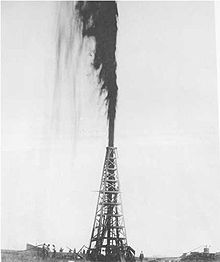
January 10, 1901 was a big day in Texas history; so big that what happened that day is still dominating both the Texas economy and its pop culture.  Whether it is the movie “Giant”, the television series “Dallas”, or the football team formerly known as the “Oilers”, oil and Texas go together like peanut butter and jelly. Since 1892 Patillo Higgins had been trying to find oil on a salt dome just south of Beaumont called Spindletop.  Nearly out of money but not faith (isn’t that always the case), Higgins looked for a partner.  Hearing about the drilling effort in Texas, Anthony Lucas decided to head to Beaumont and partner with him, bringing both greatly needed capital and drilling experience.  Lucas was drilling that January morning when at 1139 feet below the surface, first mud, then gas, then oil blew out of the hole.  As Jed Clampett would later say, he had discovered black gold, Texas tea.  The oil industry that we know today literally exploded onto the scene.  Millions of barrels of oil flowed out of the Spindletop oil field and hundreds of oil companies were born.  Within 10 years, dozens of salt domes were explored and oil fields discovered all along the Gulf Coast. As exploration techniques improved, oil was found in also every region of Texas.  Boom towns started popping up in Kilgore, Desdemona, Burkburnett, Wink and Borger.  There is great risk in drilling for oil and there were many more dry holes than discoveries, but taking a risk is in a Texan’s DNA, so drill they did.  Millions of barrels a year of production became million barrels a day statewide.  Fortunes that would impress Warren Buffet or Bill Gates were made every month somewhere in Texas.  And fortunes were also lost every month.  Since most of the land where this oil was being discovered was owned by either common everyday Texans or the State of Texas, you did not even have to invest in a well to make money.  You just needed to lease your land and hope that it held an oil reserve below.  Mailbox money was born.  Many of these tough, independent, hard working people now had something else; money and lots of it.  But the fun died with the stock market collapse of 1929 and The Great Depression brought down many a millionaire.  Oil prices dropped to as low as 5 cents a barrel in the 1930’s.  But when the nation went to war in 1941, it floated to victory four years later on a wave of Texas oil.  From Spindletop until 1980’s, oil and natural gas was the single largest component of the Texas economy.  Combine this wealth from the land with a relatively small and generally self-reliant population (only 9 million people lived in Texas as late as 1960), taxes were low and government services were scarce.  Things have changed some today as the population has grown and more people moved into urban areas, but much of the reason that the Texas stereotype exists today is because of the role that oil has played.

So there you have it, People, Land, and Oil.  You put it all together and you have a good window into the soul of a Texan.  But wait, some of you are saying that I am missing the greatest part of Texas culture.  Ah, you may be right about that, but you will have to wait until August to read that chapter.


“I have said that Texas is a state of mind, but I think it is more than that.  It is a mystique closely approximating a religion.”  John Steinbeck 1962
So what’s the BIG deal about Texas Anyway
By Dave Roberson

Thursday, March 22, 2012

Friday, March 9, 2012

Did You Know?

Did you know that Africa is a landlocked country, so it is hard to trade there?

I sure didn't....I guess I learn something new everyday. 


 Now in all serious...I'm proud that my students try to use new vocabulary like "landlocked" in their essays, (even if they use the word wrong) but i'm still kind of worried that some think that Africa is a country.  They know that the Suez Canal cuts trade time in half, and they know where it is located, but they still struggle with the difference of a Continent vs Country.  

The good news.......everyone can now point to Africa on the map!!!!  Believe it or not, that is a big step for some from the first of the year.....YAY


Tuesday, March 6, 2012

Remember The Alamo


“remain in this fort…resist every assault, and to sell our lives as dearly as possible.  I now want every man who is determined to stay here and die with me to come across this line.”  Colonel Travis at the Alamo, March 5, 1836


By the time dawn broke on March 6, 1836, those Texans still alive within the walls of The Alamo surely new the end was near.  The Mexican army of several thousand strong was advancing on 200 or so defenders from all directions.  For 13 days, the Texans had withstood cannonade and infantry assaults.  But during that pre-dawn Sunday morning, General Santa Ana had unleashed his entire force.  Before noon, the battle was over.  Except for a couple of women and their children, everyone fighting within the walls was dead.  This is not an attempt to re-tell the battle; there are plenty of books and Hollywood films that have done that.  I will however attempt to give a reason as to why these men so willingly gave their lives that day.

At first glance it would seem that there would be no reason whatsoever to fight for a place that would come to be called Texas.  As late as 1820, there was only a very small population living in the land between the Rio Grande and Sabine Rivers.  In fact, there were so few people living in the entire northern portion of Mexico that two of its states, Texas and Coahuila were combined into one with the capital in Saltillo.  About this time, Moses Austin was petitioning the Spanish government in Mexico City for a land grant to bring in colonists to settle land along the Brazos River.  In 1821, shortly after gaining Spanish approval, Moses Austin died and the Mexicans drove the Spanish out of Mexico.  Stephen F. Austin took over the land grant from his father and successfully convinced the infant Mexican government that the colony his father was preparing should be established.  From 1822 to 1824, the first settlers began arriving and have become known as the Old 300.  The land called Texas would never be the same.

There are many rivers bigger than the Brazos, Colorado or San Bernard and other lands more fertile than these, but for the people who came to Texas, it wasn’t just any land, it was their land.  They came mostly from Louisiana, Alabama, Arkansas, Tennessee, and Missouri, were generally Protestant Christians of British ancestry, fiercely independent, brash, and quick to speak out.  Their hosts were of Spanish ancestry, familiar with subservient living under royalty, and Roman Catholic.  A clash of some kind was inevitable, a matter of when, not if.  By 1828, there were an estimated 1200 families living in Austin’s colony.  Other colonies were established later and by 1834 there was an estimated 9000 people living in Texas.  As word spread throughout the U.S. of the almost endless amounts of land available in Texas, thousands began to pour in, not always worrying about the details of paperwork with the Mexican government.  By 1836 it is estimated that 35,000 people lived in Texas, mainly on the coastal plain, along the inland riverbanks, and scattered throughout the forest of East Texas.  That is 35,000 independent minded, self-sufficient landowners and a few hundred Mexican officials trying to collect taxes and enforcing Mexican law.  It would take an army to gain control of Texas and in late 1835 that is exactly what the government in Mexico City did when Santa Ana began sending his north.  After several skirmishes in late 1835 and January 1836, the first big test for Texans would start the afternoon of February 23 when the leading edge of Santa Ana’s army reached San Antonio.

But this still does not tell us why 200 men went to San Antonio to fight the Mexican army.  After successfully pushing a Mexican garrison out of San Antonio in December 1835, they still had time to think about what was about to happen.  General Sam Houston had ordered San Antonio evacuated and the old mission there blown up.  But the men did not consider themselves soldiers in an army subject to orders from someone not at the fight; they were just fighting men organized as a militia, with each militia commander doing pretty much whatever he get his men to do.  The two leading militia leaders in San Antonio that winter were Jim Bowie and William Travis.  They had reclaimed San Antonio from the Mexican army and they had no intention of just giving it back.  But still,
they knew that a huge military force was headed to San Antonio and most if not all the men there still had relatives back in the U.S.  They could have decided that this experiment of living under the Mexican government was not at all what it was advertised to be and could have just gone back to from wherever they had come.  But they did not.  There was some kind of crazy mixing of land, culture, and dreams that fueled their desire to stay and that crazy brew is still alive today.  And that old mission, well it just happened to be known as The Alamo.  Twice James Bonham would leave the fortress, breaking through the Mexican lines with letters from Colonel Travis pleading for more volunteers; and twice he would return to the fight.  Some men from Gonzales made it in, but that would be all that would make it.  By the time Travis gathered his men together on March 5, he knew the last chance to leave The Alamo was near.  With a line in the sand, he asked who would join him.  Everyone, including a very ill Jim Bowie crossed over.  One last time a rider left The Alamo with Travis’s famous letter.  The rest made their peace. They were no longer Americans from their past and they were not going to become Mexicans in the future.  Their ancestors had fought the British twice, once for independence and once for survival.  It was now their turn to fight for this new land and a country of their own.  

Santa Ana would lose 600 men that Sunday and his army lost a lot of its fighting spirit.  Before April would end, Texas would be a free and independent country.  For the next 9 years, Texas would answer to no other sovereignty.  Some say that we still do not.  Maybe David Crockett said it best when he was leaving the U.S. Congress in 1835, “You may all go to hell, I will go to Texas.”  Crockett and some 200 others died March 6, 1836.  But from their death a new people were born; those people are Texans.

The Men of The Alamo
by Dave Roberson


Monday, March 5, 2012

An Ode to Bluebonnets

Since my dad is tributing this month, and most of April (ok, 21 days of April) to Texas, I thought I would put in my 2 cents.  For those of you who have never been to the best state in the world, you have probably never seen this flower....


Ok, so it looks like a plain ole flower, right?  WRONG!  Now that spring is springing quite early here, this little flower is popping up all over the place.  And the good news, this little blue flower has millions of friends and together, it is one beautiful sight to see.

So here is to Texas' State Flower,  The Bluebonnet.


SO HERE'S TO YOU....